

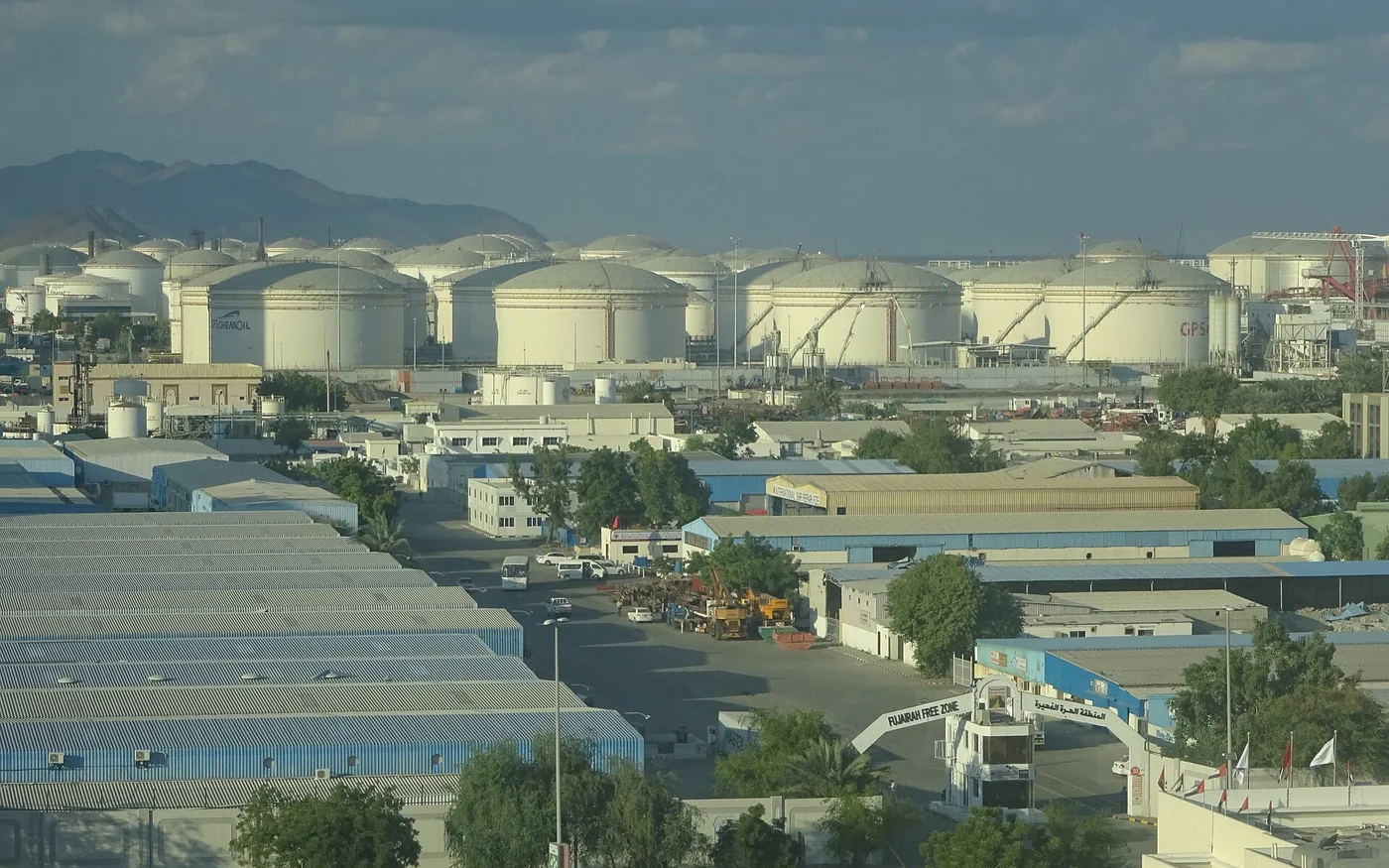
A vessel can stop off Fujairah for fuel, food, parts or a crew change without unloading the cargo it carries. For a local supplier, that stop could generate a purchase. For a port analyst, it could count as an anchorage call. For an economist, the relevant contribution depends on which services were produced in Fujairah and what inputs those services used. Those are three readings of the same movement, and each requires different evidence. Fujairah Ports Authority anchorage overview, Fujairah Ports Authority service categories.
The maritime economy links fuel and cargo handling to smaller transactions that can be easier for a local business to serve. A ship chandler needs to know which agent can place an order and when the ship can receive it. A repair company needs the vessel’s equipment details and the time available for the job. A reader estimating economic contribution needs evidence of local work and a consistent statistical boundary. Start with the port’s activity figures, then follow the movement through the services that surround it.
What the published measures count
In May 2025, the Port of Fujairah described the scale of its operations as close to 120 million metric tonnes of annual cargo throughput, about 5,000 port calls and more than 12,000 anchorage calls. These are rounded operating figures in a dated release. The separate anchorage page gives close to 12,500 vessels calling at the anchorage in 2023. The Authority’s open-data summary also lists port and anchorage figures, but it does not show a reference year beside those headline counts. Use the dated descriptions as scale context and look for explicitly matched periods and definitions before calculating growth. Port of Fujairah May 2025 release, Fujairah Anchorage Area, Fujairah Ports Authority open data.
| Measure | What it describes | Evidence needed for the next decision |
|---|---|---|
| Port call | A reported vessel call within the port series | Vessel type, terminal, berth window and cargo or service requirement |
| Anchorage call | A reported call within the offshore anchorage series | Purpose of the call and whether an agent needs a service |
| Cargo throughput | Physical cargo handled in the reporting scope | Cargo type, handling steps and charges attached to the move |
| Bunker sales volume | Marine fuel sold in the source’s reporting unit | Fuel grade, quantity, delivery service and local costs |
| Transport and storage value added | Contribution from a broad economic activity in Fujairah’s accounts | A documented breakdown if the question concerns maritime activity alone |
| Supplier orders | Actual work commissioned by named buyers | Handover, direct costs, repeat demand and payment timing |
A vessel can make repeat calls, and a call can involve several services. The headlines also do not establish whether the same vessel appears in both the port and anchorage records. Adding the counts would require a defined rule for which events are in each series and how they overlap. A seller with an agent relationship can maintain a smaller, more useful log. Record the vessel reference, location, request and service completion separately. Then measure how often an eligible call generated a quote and how many quotes became orders.
Anchorage services are part of the local supply chain
The Fujairah Ports Authority lists services at the anchorage including bunkering, crew changes, ship chandling, fresh water supply, spare parts, minor ship repair and underwater hull cleaning. Its Service Harbour description identifies facilities for loading stores and spare parts, picking up and dropping off crews, and transferring cargo from land to a supply boat. These are distinct jobs with different suppliers and costs. A vessel ordering stores can generate work for a warehouse, driver and launch operator before the goods reach the ship. The service directory identifies these activities and provides a starting point for locating providers. Fujairah Ports Authority service providers, Fujairah Service Harbour.
Take a ship that asks for spare parts during an anchorage call. The order might include the part, storage, delivery to the harbour and transport out to the vessel. Check who confirms the specification, who accepts the delivery and whether the supplier or buyer arranges the launch. A local distributor can benefit from supplying and handling a part produced elsewhere. The entire price of that part would overstate what was created by the local service. If two Fujairah suppliers both invoice for stages of the same order, identify where one invoice is an input to the other before adding their contributions.
DP World UAE’s June reel shows ships and describes the use of alternative routes across its network. It illustrates how logistics providers frame changes to the movement of goods. Assess activity in Fujairah from local service records and confirm the planned handovers for a shipment separately. DP World UAE on Instagram.
Marine fuel volume answers a different question
Bunkering supplies fuel for vessels. Fujairah Oil Industry Zone’s statistics page distinguishes bunker sales from oil inventory reporting. WAM, citing FOIZ data, reported 635,835 cubic metres of bunker sales for January 2026, up 6.1% from December and 1.1% from January 2025. The two growth rates use different comparison periods. The volume describes fuel sold in the reported month. It does not say how much fuel was in storage on a particular date or how much ships carried as cargo. FOIZ statistics, WAM reporting FOIZ January 2026 figures.
Keep cubic metres and metric tonnes separate. A conversion requires the density and measurement basis for the fuel being counted. A published monthly volume can help a supplier track activity over time, but it does not give the margin earned on the fuel or the amount of work available to a barge operator. The same volume could be delivered in fewer large jobs or more small ones. To forecast work, a provider needs to know which vessels it can serve, the grades it handles, the average lift size and how delivery windows affect barge time. Actual orders and completed deliveries can establish those quantities more directly than a market total.
Liquid bulk cargo also has a separate role. The port’s own history describes facilities handling crude and refined products connected to terminal storage companies. Cargo moving through those facilities can support handling and storage activity even when the cargo itself is not produced locally. An economic estimate should distinguish the value of the product from the value of the handling and storage work. A commercial estimate can go one step further by identifying who commissions each service and when the work is done. Fujairah Ports Authority port overview.
What Fujairah’s accounts can establish
Fujairah Statistics Center’s financial and economic chapter gives estimated 2024 GDP of AED29.130 billion and a transportation and storage line of AED3.099 billion, both in the same table. The latter represents about 10.6% of the reported total on that basis. The table gives a broad economic activity and does not isolate the maritime component. Transport and storage may cover work outside the port, while businesses supplying maritime activity may appear elsewhere in the accounts. The figure is useful as context for the scale of the broader activity. A Fujairah maritime GDP estimate would need a documented boundary, source data for the activities included and a method for avoiding overlap. Fujairah Statistics Center, table 13-12, UAE Government Fujairah profile.
Value added and invoice totals answer different questions. Suppose a Fujairah service business invoices AED10,000 for a job and uses AED6,000 of purchased goods and services in delivering it. In a simplified example, its gross value added is AED4,000 before accounting for the distribution of that amount between labour compensation, operating surplus and other components. If some of the AED6,000 was paid to another Fujairah producer, the local value created by that producer would need separate calculation. Adding both companies’ invoice totals would count purchased inputs again. This illustration explains why cargo value and supplier turnover cannot directly substitute for an emirate GDP measure.
Measure the work a supplier can actually win
Imagine a Fujairah marine supplier with eight requests for scheduled deliveries in a month. It confirms the ordering agent, the compatible product and the handover window for five. Suppose three become orders of AED2,400 each. Product and packing cost AED1,300 per order and the supplier pays AED400 per trip for the agreed handover. At three orders and three trips, revenue is AED7,200 and contribution before fixed costs is AED2,100. If two compatible orders can share one trip with no additional trip cost, contribution rises to AED2,500. These figures are hypothetical. The shared trip depends on the vessel locations, timings and service arrangements actually agreeing.
The quote log should also record requests that fell away. A mismatch in part specification calls for a different response from a boat that could not make the delivery window. If the pattern is repeated, use it to adjust inventory or service coverage. A buyer who settles several vessel orders centrally may create reliable demand, but concentration in that one buyer can affect cash if payment slips. Keep invoice acceptance and payment dates with each order.
For a regular update, write down the scope and unit of the newest port or fuel figure before comparing it with a prior release. Use local service directories and dated ship or terminal information to narrow the list of buyers. Measure accepted orders, completed work and contribution at the service level. A supplier can then track Fujairah’s maritime activity, the opportunities it can serve and the work it actually performs in separate records.
A useful check is to reconcile scheduled jobs against completed jobs at the end of the month. Note whether a cancelled job left purchased goods in stock or incurred a launch fee. These two outcomes have different effects on cash and on the next quote. A confirmed delivery may also carry a second cost if the handover changes after the goods leave the warehouse. Log these differences by order so an unusually busy month does not hide higher fulfilment costs.
Questions to ask before sharing an estimate
Does more cargo mean more demand for every maritime supplier?
Demand depends on what moved and what the movement required. A rise in bulk throughput can be relevant to loading equipment without producing a corresponding rise in crew changes or spare-parts orders. Compare activity for the vessel type or cargo your business can serve and look for orders that fit that activity.
Does the price of fuel bought in Fujairah count as local value?
The fuel sale creates revenue for the seller. Local value added depends on the activity carried out locally and the goods and services consumed in making that sale. The purchase price of fuel, barge costs and locally produced services belong in their own rows. Keep volume, revenue and value added separate even when all relate to one delivery.
Can I use the 2024 transport and storage figure as the current size of the maritime economy?
Use it as a dated estimate for a broader activity. A newer total for all of Fujairah would still require a matched sector breakdown and a defined maritime scope before it could answer that question. For a specific service, current operating records and a verified customer pipeline may be more useful than an estimated share of the emirate’s economy.



Comments (0)
No comments yet. Be the first!