

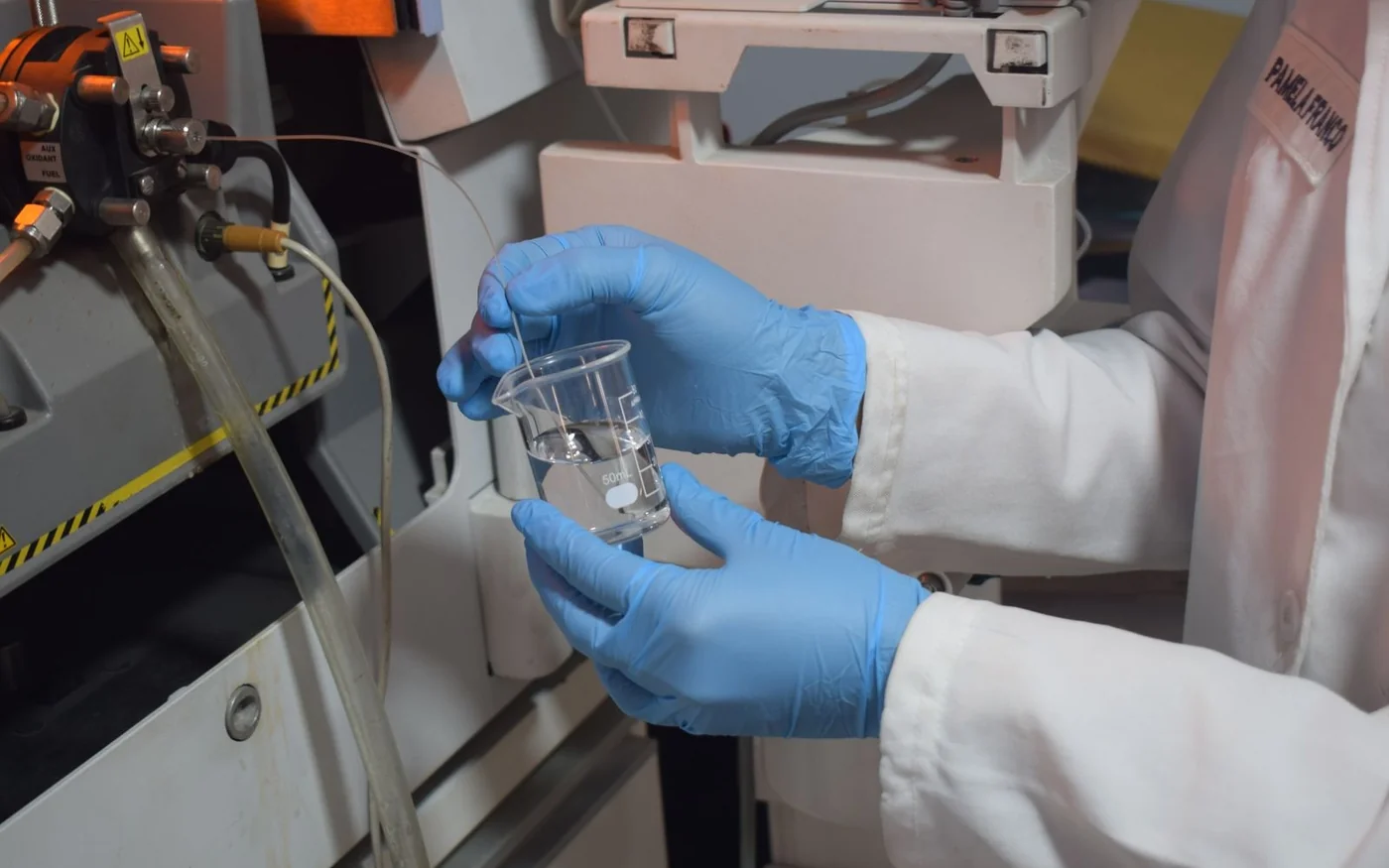
At Masdar’s Ghantoot desalination pilot, the water coming out of one process became the subject of another experiment. Reverse osmosis produced fresh water and left behind a more concentrated stream called brine. Abengoa’s pilot used membrane distillation to try to recover more water from that stream. A team led by Hassan Arafat at Masdar Institute took brine from the pilot into a small test unit and compared five commercially available treatments intended to limit deposits on the membrane. Masdar says the results informed which treatment and dose to use at the pilot. Masdar’s programme report, research and development section
That is a specific way a water researcher can move an idea beyond the laboratory. The field site supplies a sample and an operating question. The lab isolates variables. The result comes back as a decision an operator can try. A separate project led by Arafat under the same programme modelled the design and cost of solar-powered desalination. The two projects help explain what field trials and simulations each contribute before an operator commits to a bigger installation. Masdar programme report · Khalifa University’s profile of Hassan Arafat
Start with the water the plant actually sees
Masdar selected Ghantoot, Abu Dhabi, for its access to seawater and existing utility connections from a decommissioned desalination plant. Four plants were part of the initial programme and a fifth joined later. Masdar announced the programme’s outcomes in January 2018 at the International Water Summit during Abu Dhabi Sustainability Week. The location made it possible to test equipment in coastal conditions while the research teams worked on problems arising in the pilots. Masdar site selection announcement · Masdar’s January 2018 outcomes announcement
Abu Dhabi Sustainability Week’s January 2025 Instagram reel introduces a later edition of the forum. It gives a sense of the setting in which the programme’s earlier results were presented.
At Abengoa’s pilot the researchers focused on fouling, a term for material building up on or in a membrane. The deposits can interfere with the movement of water through a system and make it harder to sustain the intended output. Mineral deposits are often described more specifically as scaling. Masdar’s account says the team used the lab unit to test membranes and brine configurations under operating conditions corresponding to the pilot. In this case the connection between field and bench mattered because the treatment was supposed to work on the concentrated stream the pilot actually produced. Masdar report, fouling in membrane distillation
Think about the equivalent decision at a fictional UAE treatment site. A laboratory study might find that a membrane works well with a prepared solution. Before choosing a field dose or cleaning interval, the operator needs to know how that setup behaves with the site’s real feed. Have the field team record when and where it collected the sample, how conditions varied and what earlier treatment the water received. Then have the lab state which of those conditions it reproduced. A result from the prepared solution remains useful for understanding the mechanism. A result from a traceable plant sample answers a different question about the system that will receive the treatment.
Turn a promising result into an operating instruction
The programme report describes the use of the test results to determine which chemical and dose should be used at Abengoa’s pilot. It gives no dose recipe for readers to reproduce or verified long-term saving from that change. The operational lesson is in how the question was framed. The team looked at a decision the plant could make, using a test stream it could identify and candidate treatments it could compare. Another operator would need an equivalent process for its own water, equipment and operating limits. Masdar report, research and development section
A research team can make that handoff clearer by giving the operator a short statement of the evidence behind the proposed change. Include the conditions tested, the outcome that mattered and the range over which the result is supported. Agree how to check water quality and what should happen if performance worsens. Name the person who can return the pilot to the previous operating setting. That gives the operator a decision they can monitor rather than a broad request to implement the experiment.
A field check can measure performance over several operating cycles. Record how the system starts, what happens after a pause, and how performance changes before and after cleaning. If a treatment appears to preserve output, see whether that comes with a change in chemical use or a new maintenance task. Have staff record the intervention and the conditions at the time. The result is easier to interpret if the team can separate a membrane effect from a shift in feed conditions or a change in how the plant ran that day.
| Decision | Evidence to carry from lab to pilot | What the operator should check |
|---|---|---|
| Choose a candidate treatment | Comparable tests using traceable feed and recorded conditions | Whether the same response appears during field operation |
| Set a cleaning review point | Output and quality observed over the test period | When performance changes and whether cleaning restores it |
| Estimate energy performance | Meter locations and a defined volume of acceptable water | Whether auxiliary loads and downtime change the result |
| Prepare a larger trial | Repeated operating records and known exceptions | Whether supply, staffing and waste handling can support the next scale |
Treat energy and scale as separate questions
The programme’s second strand involving Arafat looked at design and cost. Masdar’s report describes a modelling project that used solar irradiance and seawater temperature and salinity profiles to compare configurations. It considered seawater reverse osmosis, solar options and storage, and examined grid-connected and off-grid cases. The model helped the team see which assumptions affected the result. It did not measure the cost of building and operating a full-scale plant at every modelled configuration. Masdar report, design and cost of solar desalination
The same report describes the potential for energy consumption below 3.6 kilowatt-hours per cubic metre of produced water for reverse osmosis treating local seawater at large scale. Masdar’s programme summary presents the figure as an outcome of membrane-based testing. Read the figure with the scale qualification in the detailed report. It does not give a current electricity requirement for every UAE desalination plant, and it is separate from Arafat’s work on choosing a treatment for the membrane distillation pilot. Masdar detailed programme report · Masdar programme summary
When a buyer compares two energy figures, ask which equipment the meter covers and which water counts in the denominator. Suppose a fictional skid uses 360 kWh and produces 100 cubic metres that meet the pilot’s agreed target in a day. Its measured intensity is 3.6 kWh per cubic metre. If intake and pretreatment use another 40 kWh outside that meter, including those loads brings the intensity to 4.0 kWh per cubic metre. Both figures describe the same fictional day. The comparison only works when both suppliers use the same boundary and the same definition of usable output.
Also ask what happens in hours when the energy source cannot support the intended output. A plan can use the grid, storage or a different operating schedule, depending on the project. Each choice changes what the plant needs and what the customer can rely on. The field team can compare meter data, periods of curtailed output and the quality of water after restarting. The modelling team can use those observations to revise its assumptions about how much equipment or storage a bigger system would need.
Keep the comparison useful when conditions change
For a longer trial, agree on what a fair comparison looks like before introducing the treatment. If two test runs use different batches of feed, log the difference and check whether it could explain the result. Where the facility can support parallel runs, it may be possible to compare settings during similar conditions. Where runs have to occur one after the other, make room for a baseline period and a return to that baseline if the operator can do it safely. A report that records the sequence gives readers more to work with than an average for each setting.
Agree how the lab and the operator will describe a failed run. A result can be unusable because an instrument lost calibration, because the water did not meet the agreed target or because the process could not hold a steady condition. Keep these cases visible in the record. A buyer planning a larger site needs to know how often tests could run and why they stopped. A sequence of strong results after excluding difficult starts may give a poor basis for deciding what to install.
The same discipline applies to costs. Put membrane replacement, consumables, labour and concentrate handling beside the energy calculation. A design that looks attractive with uninterrupted operation may need more staff time or spare equipment once it is exposed to real maintenance cycles. Ask the commercial team to show how a change in operating hours affects the cost per cubic metre. Then use the next field run to test the assumption with the largest influence on that cost.
Decide what the next site still needs to prove
A repeatable result at a pilot is a basis for the next decision. An operator considering a larger trial can ask what will change in feed quality, duration, staffing and maintenance. It can also ask where the remaining concentrate will go. Recovering more water can reduce the volume of brine while changing its concentration. A trial needs a clear record of both streams and the handling that would be required at the next site. Confirm who owns those decisions before assuming an improvement in recovery is an improvement in overall operating cost.
At Ghantoot, the value of the laboratory project was that it returned a specific choice to an operating pilot. The modelling work answered another part of the commercial question by showing how different power and desalination configurations could be compared. Keep both kinds of evidence in the next investment review. The field record shows what happened to actual water and equipment. The model shows how the economics might change when assumptions about scale, hours or power change. The strongest proposal makes those assumptions visible and identifies which ones still need evidence.
For a researcher preparing the next UAE trial, write down the choice the host will face at the end. It could be whether to use one treatment, extend the run through a different season or fund engineering for a larger unit. Then specify the conditions under which the host can make that choice. If a pilot report answers that question and tells the next operator how to check the result, the work can travel beyond the original site without losing the context that made it useful.


Comments (0)
No comments yet. Be the first!