

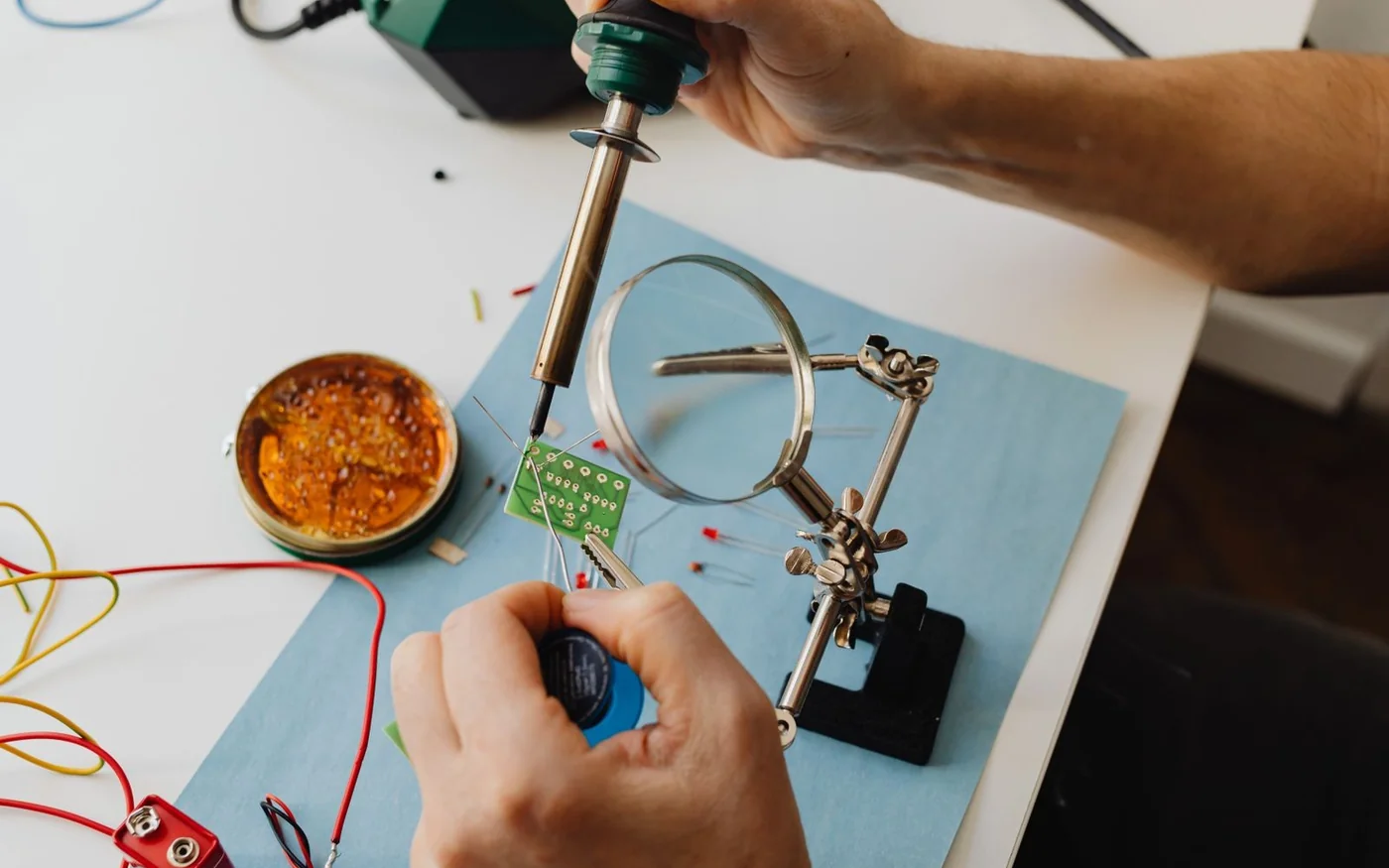
A repair workshop and a refurbished goods retailer can use the same workbench while carrying very different commercial risks. In the first business, a customer owns the faulty item and pays for an agreed service. In the second, the business buys an uncertain asset, spends money restoring it and hopes to sell it at a price that also funds returns and warranty work.
Before committing to premises in Dubai or elsewhere in the UAE, choose which of those transactions you intend to make repeatable. Then validate three things together: access to suitable parts and repair capability, a customer offer you can support after delivery, and demand at a price that covers the failures as well as the successful jobs.
Consumer electronics provide a useful worked example because condition, data, components and warranty expectations meet in one sale. The same commercial questions can inform other repair categories, but their safety requirements, technical competence and permissions need their own assessment. A phone refurbishment plan does not establish readiness to rebuild industrial machinery or service regulated equipment.
Choose who owns the item and pays for uncertainty
Start with a single customer, product family and transaction. “Repair and refurbishment” is too broad to price, staff or license as an operating brief. A business restoring customer laptops faces different stock exposure from one purchasing mixed used laptops for resale, even if both employ the same technician.
| Model | What the business earns from | Main uncertainty to resolve |
|---|---|---|
| Customer owned repair | Diagnosis and an approved repair service | Whether the fault can be identified, quoted and repaired within the promise |
| Purchase refurbish and resell | Sale of an item the business owns | Acquisition quality, successful refurbishment, selling price and after-sale costs |
| Business fleet refurbishment | An agreed project for a customer's asset batch | Asset records, acceptance tests, data instructions and usable output |
| Brokerage or subcontracted service | An explicitly defined coordination or sales role | Who contracts with the customer and remains responsible for defects and claims |
For customer owned repairs, decide what happens when a customer declines the quote, a fault cannot be reproduced, or a repair becomes uneconomic after opening the item. A diagnosis charge, approval limit and collection arrangement need to be understood before intake. Receiving an item is not permission to make every repair or access its contents.
For resale, establish who owns each incoming unit and whether the seller has the right to transfer it. Record identifiers, purchase evidence, known faults and any account or organisation locks. An attractive purchase price is of little value if the unit cannot legitimately be released, tested or sold. Keep disputed or unresolved stock outside saleable inventory.
Use this model choice to prepare the activity and premises brief for the relevant UAE licensing authority. Describe repair services, used goods purchasing and resale, online sales, storage and any waste handling you propose. Obtain confirmation of the applicable activities and approvals for that location before signing a long lease or advertising the service. Treat manufacturer programme acceptance as a separate question from permission to operate the business.
Test demand for a defined offer
A competitor selling refurbished devices establishes that an offer exists. It does not establish demand for your stock, repair standard, location or acquisition cost. Nor does enthusiasm for lower prices establish willingness to buy a particular used device with a particular battery condition and warranty process.
Build two offer descriptions before buying a broad stock range. One could be a diagnosis and repair service for a limited set of laptop models. The other could be a clearly graded refurbished laptop sold with a documented condition report and defined support route. Give each an intended customer, expected turnaround, price basis and exclusions. These are offers to test, rather than promises to make before operational readiness.
When validating with prospective buyers, ask about the last comparable purchase or repair. What failed? Who approved the spend? What made the alternative acceptable? Was the decisive issue price, disruption, confidence in the condition, data handling or the ability to obtain a replacement? A business buyer may value a consistent specification and asset register more than a cosmetically superior individual machine.
For a pilot, track enquiries through approved quotes, completed jobs, accepted deliveries and collected payments. Keep customer cancellations separate from technical failures. Record why quotes were declined and which missing component prevented completion. A queue of enquiries for unsupported models can consume time without validating the business you plan to build.
Keep repair demand separate from resale demand. Someone willing to spend a modest amount extending the life of an existing laptop may not buy a refurbished replacement from the same supplier. Equally, a buyer seeking a batch of matching devices may have little interest in walk-in repairs. Choose the sales channel and service process that fit the transaction you have actually tested.
Establish parts access before quoting turnaround
An available technician does not make every device commercially repairable. The required component, diagnostic resources, configuration steps and testing capability must also be available for the exact model and fault. A component that fits physically may still be unsuitable for the performance or status you advertise.
Apple provides a concrete UAE example. Its Independent Repair Provider programme describes access for qualifying companies to genuine parts, tools, training, guides and diagnostics for specified out-of-warranty iPhone and Mac repairs. The UAE page is accepting business applications, but meeting its requirements does not guarantee acceptance. It also states that parts resellers and distributors are ineligible for that programme. Access should therefore be validated against your actual business model, rather than assumed from the availability of an application form.
For each proposed repair family, build a parts record showing the component specification, supply route, lead time evidence, return conditions and method of checking suitability. Distinguish new genuine components, other replacements and recovered components in your internal records and customer descriptions. Do not use manufacturer branding to imply an authorisation or certification you have not obtained.
Order quantities should follow fault patterns and consumption observed in the pilot. Buying a broad catalogue can tie up cash in components for devices you rarely receive. At the other extreme, relying on a single uncertain shipment makes a fixed turnaround promise fragile. Decide which repairs you can quote confidently, which need a parts confirmation first, and which you should decline or refer to a suitably capable provider.
Include failed components and supplier returns in this assessment. A low purchase price can be outweighed by rework, repeat collection and delayed customer delivery. Compare the total cost of obtaining a successful repair, with records of the failures, rather than comparing component invoices alone.
Make condition a testable product description
A refurbished product needs a specification that sales, technicians and customers can interpret consistently. Separate cosmetic condition from function. A clean case does not establish battery condition, storage health, connectivity or the absence of an intermittent fault.
Revibe's UAE frequently asked questions illustrate how a seller can define separate grades using appearance and battery criteria. Those are that seller's published standards, not a UAE grading system or a benchmark every operator must adopt. Create definitions that match what your own process can measure and deliver.
For each item, link the intake record to the work performed, test results, components changed and final sale description. Define who releases it for sale and what evidence that person checks. Where a test cannot establish a claim, narrow the claim. Avoid presenting an untested property, such as water resistance after repair, as restored simply because the device powers on.
UAE consumer disclosure requirements matter here. Article 7 of the consumer protection executive regulations requires clear disclosure of the condition of used or refurbished goods, including on the goods and at the provider's place of activity, without creating a misleading impression. The condition must also be recorded in the contract or invoice. Article 8 addresses misleading statements including warranty terms and quality marks. A pleasant grade name therefore needs an accurate underlying description.
Build the sales page, item label, invoice and support record from the same approved information. If the listing says a component has been replaced, the workshop record should identify that work. If visible wear changes the grade, update the listing before sale. A customer should not discover the meaningful qualification only after opening the package.
Revibe's official renewed-tech post provides an example of customer-facing category education; it does not demonstrate another business's testing quality or commercial results.
Price the unsuccessful units as well as the successful ones
For resale, the margin on one successfully refurbished device is an incomplete measure. A purchased batch can include units that cost money to assess but cannot be restored economically. Some completed units may remain unsold or need further work. Calculate the result across the whole acquisition batch.
Consider an invented pilot of 100 used devices purchased for AED 200 each. Assume 80 are successfully refurbished and sold for AED 450 each, while 20 rejected units have a permitted net recovery value of AED 50 each. Assume assessment costs AED 20 for every acquired unit, refurbishment costs AED 80 for each saleable unit, and selling and fulfilment cost AED 30 for each sold unit. Set aside a further illustrative AED 25 per sold unit for expected warranty claims.
| Invented batch calculation | Amount |
|---|---|
| Sales from 80 devices at AED 450 | AED 36,000 |
| Net recovery from 20 rejects at AED 50 | AED 1,000 |
| Acquisition of all 100 devices | AED 20,000 |
| Assessment of all 100 devices | AED 2,000 |
| Refurbishment of 80 devices at AED 80 | AED 6,400 |
| Selling and fulfilment for 80 devices at AED 30 | AED 2,400 |
| Warranty allowance for 80 devices at AED 25 | AED 2,000 |
| Remaining contribution before other costs | AED 4,200 |
These figures are assumptions, not UAE prices, expected repair yields or accounting guidance. They assume all 80 saleable units sell and are paid for at the stated price. They exclude premises, administration, other staffing, equipment, finance, taxes and additional costs not represented in the rows. Reject recovery is assumed net of its handling costs and depends on a legitimate route; it is not permission to sell unsafe or data-bearing rejects.
Now reduce saleable output to 70 units, keeping the same per-unit assumptions and recovering AED 50 on each of 30 rejects. Revenue including recovery becomes AED 33,000. The listed costs become AED 31,450, leaving only AED 1,550 before the other costs. That is AED 2,650 less contribution from ten fewer successful units.
Use the pilot to replace these assumptions with recorded outcomes. Track the acquired batch through assessment, work in progress, sale, collection and any later claim. Do not remove failed purchases from the calculation or treat unsold stock as collected revenue. A higher advertised margin does not pay the next stock invoice while the previous batch remains on the shelf.
Design and fund the warranty promise
The sales promise creates work after delivery. Decide which entity provides support, how a claim is recorded, where the item goes, how it is assessed and how the customer receives the outcome. Separate the commercial offer from the applicable consumer obligations; a short internal policy cannot resolve those obligations by itself.
Revibe's published warranty help page describes a 12-month limited warranty with specific coverage conditions and exclusions. It includes a shorter stated period for screen issues. That is a useful reminder to compare the detailed terms with the headline, rather than treating “12 months” as a promise covering every fault, component and circumstance. It is a provider example, not a universal UAE warranty duration.
Define your own claim categories and collect evidence consistently. Distinguish a recurring repaired fault, a different fault, an item delivered incorrectly and reported damage. The operational record should support fair decisions and escalation rather than automatically rejecting a case because it falls outside a convenient internal label.
The financial allowance should include likely parts, technician time, collection, redelivery and possible replacement or refund costs. An illustrative allowance is a planning input to revisit when claims emerge. A new operation cannot assume zero claims because its first batch has only just shipped. Keep the sales cohort identifiable so that later costs can be connected to the original offer and repair process.
Also test capacity. If the same technician handles paid repairs, refurbishes new stock and investigates warranty returns, growth can delay existing customers. Decide how warranty work enters the queue and what happens when the required replacement part is unavailable. Support that has no time allocated to it is an unfunded operating promise even when a cash allowance exists.
Control custody and customer data
For electronics, agree what the customer authorises you to do with the device and its data before work begins. Record the item's identifier, condition, accessories, handover and person authorised to approve work. Distinguish permission to diagnose a fault from permission to erase data or prepare the item for resale.
For business fleet projects, request a clear asset list and written instructions from an authorised customer representative. Establish how account locks, storage media and devices that cannot complete the agreed process will be handled. Keep unresolved items segregated. A unit passing a functional test is not evidence that its previous owner's information has been appropriately removed.
The current NIST media sanitization guidance, Revision 2, published in September 2025, describes establishing a sanitization programme with techniques and controls suited to information sensitivity. It is a technical reference, not a UAE business licence or an automatic finding that a particular reset procedure is sufficient. Select and validate the process with competent specialists for the actual media and customer requirements.
Set a route for items that cannot be restored or released. Confirm the receiving provider's relevant permissions and the records needed for the specific material and location. A reject is not automatically ordinary rubbish or saleable spare parts. Include storage, collection and closure evidence in the operating cost and custody plan, particularly where damaged components require specialist handling.
Expand only after a complete pilot closes
Begin with a narrow product family and a defined intake limit. Before accepting work, have the applicable permissions, competent personnel, parts route, customer documents and safe operating arrangements in place. The pilot should test the complete transaction through delivery and support, rather than just demonstrate that a technician can revive one item.
For every job or batch, compare the approved scope with actual parts consumption, labour, completion time, collected revenue and follow-up work. Review declined quotes, unrepaired devices and claims together. They show where the promise, sourcing rules or acquisition price needs to change.
Expand when the records support a repeatable offer and the cash plan can fund stock, work in progress and support. If a model produces frequent uncertain faults, narrow acceptance criteria before adding more volume. If a customer segment buys only below your fully costed price, change the offer or decline that segment. A viable UAE repair and refurbishment business starts with a controlled transaction that works through its entire life, including the items that never reach a sale.


Comments (0)
No comments yet. Be the first!